
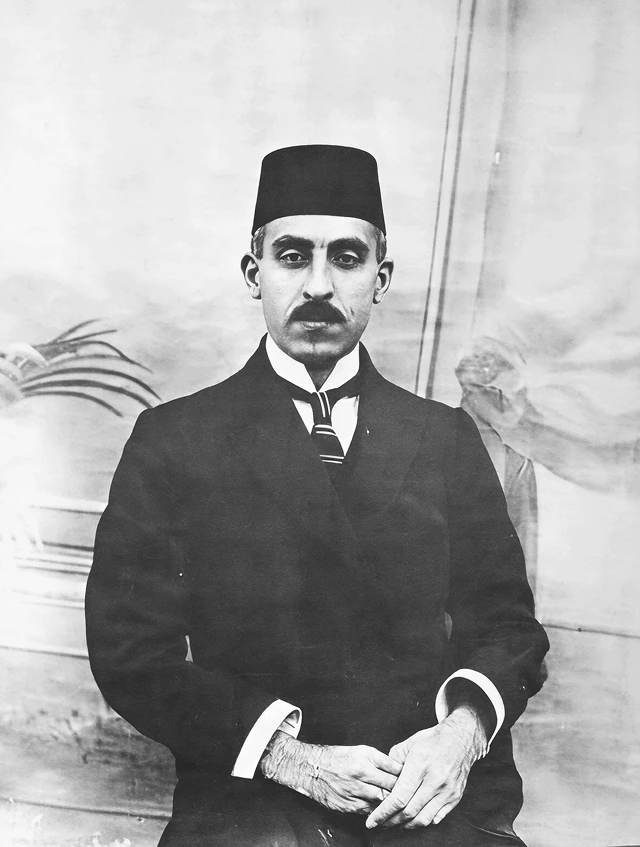
Mohammad Mossadegh
Prime Minister of Iran, 1951–1953
Founder of the National Front, 1949
Doctor of Law, University of Neuchâtel, 1914
Mohammad Mossadegh was born in Tehran on 16 June 1882 (26 Khordad 1261), into a family of notables. Hisfather, Mirza Hedayatollah Ashtiani, was a high ranking official in the Qajar treasury, and his mother, Malek-Taj Najm al-Saltaneh, was the granddaughter of Abbas Mirza, heir to the throne of Fath-Ali Shah Qajar. Mossadegh’s father died when he was ten years old. He and his sisters were then raised by their mother.
I Early Life
1882 – 1926
In 1904, Mossadegh married Zahra (Zia al-Saltaneh), daughter of Sayyed Zeyn al-Abedin Zahir al-Islam, the Friday prayer leader of Tehran, and granddaughter of Nasser al-Din Shah Qajar. The couple had five surviving children: two sons, Ahmad and Gholam-Hossein, and three daughters — Zia Ashraf, Mansureh and Khadijeh.
In March 1909, Mossadegh went to Europe to pursue his studies, first in France at the University of Paris, and then Switzerland, where he earned a doctorate in law from the University of Neuchâtel in 1913, with a thesis titled Le testament en droit musulman (secte chiite). Mossadegh was the first Iranian to receive a doctorate in law. He returned to Iran in late 1914 and began teaching in the School of Political Science in Tehran. He also published a number of works on law and finance, and would continue his interest in such topics while also becoming involved in politics and party-political life. Between 1917 and 1923, Mossadegh served in various government positions, including governor of Fars and of Azarbaijan, minister of Finance and minister of Foreign Affairs.
Mossadegh vigorously opposed the 1919 Anglo-Persian Agreement as tantamount to the imposition of British tutelage over Iran. He also opposed the British backed coup of 1921, which eventually resulted in the political ascendency of Reza Khan, a commander in the Cossack Brigade. In 1924 he was elected to the Fifth Parliament as a deputy for Tehran. While in parliament he opposed the assumption of the throne by Reza Khan (later Reza Shah Pahlavi), who was then prime minister, forcefully arguing that it would undermine Iranian constitutionalism and lead to dictatorship. In 1926, he was elected to the Sixth Parliament, where he continued to oppose any moves, measures and policies he considered incompatible with the public and the national interest.
II Post-1941
1929 – 1951
With the consolidation of Reza Shah’s authoritarian rule, from 1929 to 1941 Mossadegh lived in political seclusion, under state surveillance, away from Tehran, mostly in the village of Ahmadabad. He was arrested and imprisoned for a few months towards the end of Reza Shah’s reign, but following the Allied occupation of Iran and the consequent abdication of the Shah, he eventually returned to the capital as Iranian civic and parliamentary life was revived. In February 1944, he was elected as Tehran’s first deputy to the Fourteenth Parliament, earning the highest number of votes in the capital. In this capacity, among other achievements, and in the wake of a Soviet oil demand, he sponsored the passing of a bill forbidding any discussion regarding the granting of concessions to foreign powers while the country remained occupied.
Taking advantage of an assassination attempt on his life on 4 February 1949, the Shah proceeded to organise a Constituent Assembly, thereby achieving his long-cherished objective of formally increasing his prerogatives. In order to counter growing royalist anti-democratic activities, Mossadegh, together with a number of likeminded politicians and journalists, formed the National Front in the autumn of 1949, with the aim of protecting electoral and press freedom and opposing martial law.
In April 1950, despite extensive machinations by the royal court and the British embassy, Mossadegh and six of his supporters were eventually elected to the Sixteenth Parliament. Mossadegh again gained the highest number of votes in the capital. Despite its size, this group exercised enormous political influence over Iranian politics, representing what was coming to be widely regarded as a Mossadegh-led national movement.
Mossadegh’s fundamental constitutional position was that the Shah, who was not politically accountable, was merely a ceremonial monarch, not a ruler with executive power. He succeeded in discomfiting US and British backed prime minister Haji Ali Razmara, and foiled any resolution of the Anglo-Iranian oil dispute that would be detrimental to the national interests of Iran. On 20 March 1951 (29 Esfand 1329), the parliament eventually voted to adopt the nationalisation principle. Five weeks later, in late April, Mossadegh was voted in as prime minister by the parliament with near unanimous support.
III Premiership & Overthrow
1951 – 1953
Following his assumption of the premiership and the formation of a cabinet of reputable political figures, Mossadegh sought to proceed with implementing the Oil Nationalisation Act, which the British adamantly refused to accept. Iranian willingness to pay fair compensation did not alter the British rejection of any deal other than a 50/50 arrangement. Within months of Mossadegh’s assumption of office, the British, in coordination with many of his domestic, mostly royalist, opponents, started a multi-faceted campaign aimed at destabilizing his government.
Qavam’s premiership proved short-lived due to pro-Mossadegh protests which culminated in the uprising of 21 July 1952 (30 Tir 1331) and the return of Mossadegh to the premiership. He would also assume control over the war ministry, which was renamed the Ministry of National Defence. Mossadegh’s resumption of office marked a major setback for the British and the royalists.
Mossadegh’s successful demand in January 1953 that his extra powers be extended for another year further antagonised his opponents. His refusal to curb press freedom and the political activities of the left had been and was now increasingly invoked as paving the way for communism. The British had made it clear that as long as Mossadegh was in office there would be no solution to the oil dispute.
The plan involved the financially induced support of parliamentary deputies in order to engineer a vote of no confidence against Mossadegh. This led to his drastic yet astute pre-emptive move of resorting to a referendum to dissolve the parliament, to be followed by fresh elections. Having been outmanoeuvred, the planners of what came to be known as the coup of August 1953 then focused on exerting pressure on the Shah, eventually forcing him to issue a decree dismissing Mossadegh.
The failure of the coup’s initial stage on 16 August led to the Shah fleeing the country; but it eventually succeeded on 19 August (28 Mordad 1332). The coup constituted the culmination of cumulative, complex and extensive covert destabilizing activities involving a variety of foreign and domestic actors, including segments of the army and lumpen elements, organized and financed by the CIA and British intelligence.
IV Post-1953: Legacy & Vision
1953 – 1967
Following the overthrow of his government, Mossadegh was tried by a military tribunal which he skilfully turned into an effective indictment of the proponents of the coup. He was condemned to three years of solitary imprisonment, which he served in Tehran. He spent the rest of his life in confinement and isolation in Ahmadabad until his death on 5 March 1967 (14 Esfand 1345) at the age of 84. His death was deliberately ignored by the authorities and no commemoration permitted. His body was interred in his Ahmadabad residence, as the Shah refused to allow his burial alongside those who had lost their lives in the July 1952 uprising, as he had expressly wished.
The constraints of confinement and police surveillance in Ahmadabad did not overwhelm Mossadegh’s spirit, and he spent his time reflecting on the overwhelming political defeat which had come in the wake of undeniable moral victory. Painfully aware of what had contributed to the vulnerabilities of the movement that he had led, he continued to reveal a strong, abiding interest in civil resistance against authoritarian rule and in the appropriate modalities of organized protest.
Most opponents of the royal autocracy would continue to see Mossadegh as an undisputedly dedicated model and source of inspiration. He would be regarded internationally as the Iranian national hero and the unrivalled face and symbol of Iran’s democratic and anti-imperialist struggles. His legacy endures in the aspirations of those who believe that constitutional governance and national sovereignty are not incompatible — that a small country may face an empire on grounds of law, and be remembered as having been right.
Historical Timeline
1882
Birth
Dr. Mohammad Mossadegh was born in Tehran, Iran.
1908
European Education
Dr Mohammad Mossdegh journeyed to France in 1908, Mossadegh later earned his doctorate in law from the University of Neuchâtel in Switzerland – the first Iranian to receive a European doctorate in law.
1949
Foundation of the National Front
Dr. Mohammad Mossadegh established the National Front to promote democracy and national sovereignty.
1951
Prime Minister of Iran
Dr. Mohammad Mossadegh became Prime Minister and nationalized Iran’s oil industry.
1952
July Crisis (“30 Tir”)
Dr Mohammad Mossadegh resigned on July 16 due to control by the Ministry of War. The popular uprising on July 21 resulted in many deaths. He was reinstated as Prime Minister with 61 votes out of 64.
1953
Overthrow by Coup d’État
Dr. Mohammad Mossadegh was ousted from power in a foreign-backed coup.
1967
Death
Dr. Mohammad Mossadegh died under house arrest, remembered as a symbol of freedom and independence.
"
its people, expressed freely and without coercion.
Dr. Mohammad Mossadegh